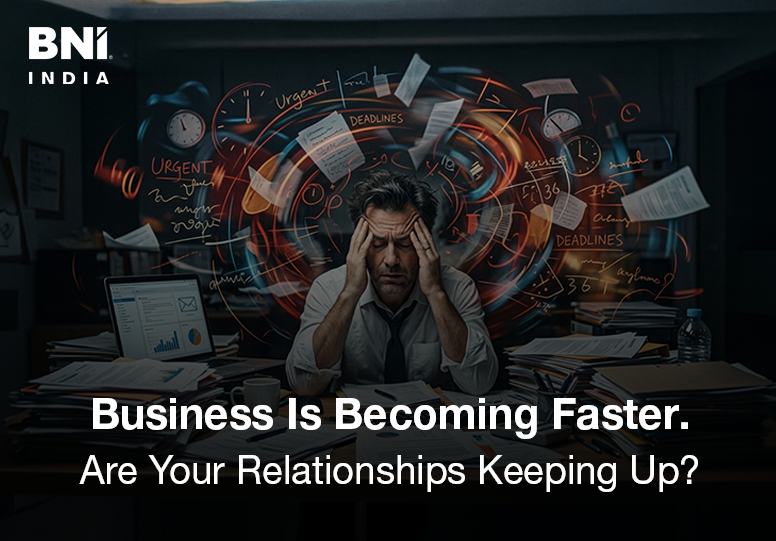
Business has always rewarded speed. But what we are seeing now is something different.
Buyers can research a company in minutes. AI can compare options before a salesperson has finished writing a follow-up email. Competitors can launch campaigns overnight. Recommendations travel through WhatsApp groups, LinkedIn conversations and professional communities almost instantly.
The time between “I might need this” and “I’ve made my decision” is getting shorter. And that creates an interesting problem for business owners.
We have invested heavily in becoming faster at marketing, selling, responding and delivering. But have we become equally intentional about the relationships that help people choose us?
Because in a faster market, relationships are not becoming less important. They may be becoming one of the few advantages that cannot be accelerated with software.
Buyers Are Doing More Before They Ever Speak to You
Think about how you personally make a business purchase today. You probably search online, scan reviews, look at LinkedIn profiles, ask someone you trust, compare a few options and perhaps even ask an AI tool to shortlist providers.
By the time you contact a business, you may already have formed an opinion. That is the biggest change in modern buyer behaviour: buyers are increasingly arriving at conversations with information, comparisons and expectations already in hand.
McKinsey’s 2026 B2B research found that buyers now use an average of ten channels during their purchasing journey. Gartner has also reported significant adoption of generative AI among B2B buyers when researching purchase decisions.
This means businesses are entering the buyer’s decision-making process later than they once did. But someone else may already be there. A trusted accountant. A fellow entrepreneur. A consultant. A business associate. A colleague who says, “I know someone you should speak to.” That recommendation can instantly move one business ahead of ten others on a search results page.
AI Can Shorten the Search. It Cannot Manufacture Trust.
AI is making business discovery extraordinarily efficient.
A buyer can ask, “Which software would work for a 50-person company?” or “What should I look for when choosing a commercial interior designer?” and receive a structured answer almost immediately. Research that once took hours can take minutes.
How is AI changing B2B buying behaviour? AI is helping buyers research, compare and shortlist businesses faster, which means companies may have a smaller window in which to earn attention and trust.
But speed creates its own problem-verification. When everything can be researched quickly, buyers still need to decide what and whom they believe.
Interestingly, Gartner’s 2026 research found that even as buyers increasingly use AI and self-service channels, many still turn to sales professionals to validate AI-generated information during important purchasing decisions.
Technology can give someone options. Trust helps them choose. That distinction matters.
Attention Is Getting Harder to Earn
Businesses are communicating in a market where everyone is communicating.
Your buyer’s inbox is full. Their LinkedIn feed keeps moving. Competitors are publishing. Ads follow them from platform to platform. AI-generated content has dramatically increased the amount of information competing for their attention.
So the challenge is no longer simply, “How do I reach my customer?” It is, “Why would they pay attention to me?”
More content is not always the answer. People notice businesses they recognise. They respond differently to names they have heard before. And a recommendation from someone they already trust can cut through an enormous amount of marketing noise.
Why are business relationships important in a digital-first market? Strong business relationships create familiarity, credibility and trust before a buying decision begins, making it easier for a business to stand out when buyers have too many choices.
That is why networking cannot sit somewhere between “post on LinkedIn” and “attend an event when there is time.”
Relationship-building has become part of business development.
Occasional Networking Belongs to a Slower Era
A lot of entrepreneurs still approach networking reactively. Business slows down, so they attend an event. They need introductions, so they message old contacts. They want referrals, so they suddenly become active in their network. The problem is that relationships rarely perform well on demand. You cannot disappear for eleven months and expect your network to become your sales team in month twelve. The businesses that benefit most from networking usually stay visible.
They have regular conversations. They learn what other people do. They explain clearly what opportunities they are looking for. They make introductions. They follow up. They help other businesses solve problems even when there is no immediate transaction attached.
Over time, people begin to understand not only what they do, but when to think of them. And that second part is where referrals begin.
How do you build stronger business relationships consistently? The simplest answer is to create a regular rhythm of meaningful interaction instead of relying on occasional networking events or contacting people only when you need business.
Your Network Needs to Move Before the Opportunity Does
Imagine two businesses offering a similar service.
Business A has a brilliant website, competitive pricing and an excellent presentation.
Business B has all of those things too. But five people in the buyer’s professional circle already know the owner, understand the business and would comfortably recommend it. When an opportunity appears, Business B does not necessarily have to convince the market from zero. Its relationships have already done part of the work. This is why structured business networking becomes especially relevant in a faster economy.
Within a network such as BNI, business owners are not simply collecting contacts. They are repeatedly learning about one another’s businesses, building credibility and developing the ability to recognise relevant opportunities.
That structure matters because relationships otherwise tend to depend on memory, convenience and spare time — three things most entrepreneurs rarely have enough of.
The Faster Business Gets, the More Intentional Relationships Must Become
There is a temptation to look at AI, automation and digital buying behaviour and conclude that the future of business will become increasingly impersonal.
The opposite may happen.
As information becomes abundant, trusted interpretation becomes valuable.
As options multiply, recommendations become valuable.
As communication accelerates, genuine relationships become easier to recognise.
And as businesses become capable of producing more content, sending more messages and automating more interactions, the ability to say “I know this person, I trust their work and I am comfortable introducing them” becomes incredibly difficult to replicate.
Can business relationships still create competitive advantage in an AI-driven world? Yes, because AI can accelerate discovery and comparison, but trust, credibility and personal recommendation still reduce the uncertainty involved in choosing whom to do business with.
The businesses that understand this will stop treating networking as an activity.
They will treat it as infrastructure.
They will deliberately build relationships around their business long before they need those relationships to produce an opportunity.
Because the next enquiry may arrive faster.
The next competitor may appear faster.
The next buying decision may happen faster.
Your relationships need to be strong enough to already be in the room when it does.
